What you’ll learn in this article
- 10 realistic habits for your 30s, each with the smallest version you can start this week
- Why consistency matters more than intensity after 30
- A simple way to pick the two habits to start with
- How to restart when a habit slips — without starting over
Most lists of healthy habits to start in your 30s assume you have plenty of time, energy, and motivation.
Real life usually looks different.
You have work. Your schedule changes. Some weeks you sleep well; other weeks you don't. Some days you have time to exercise, and some days a ten-minute walk is all you can manage.
That does not mean healthy habits become impossible after 30.
It means the habits need to become more realistic.
The basics still matter: eating well, moving regularly, getting enough sleep, maintaining muscle, and looking after your health. The challenge is turning those basics into habits that can survive an ordinary week.
So instead of giving you another perfect morning routine, here are 10 healthy habits to start after 30 — with the smallest practical version of each.
And you do not need to start all ten.
In fact, you probably shouldn't.
What actually changes after 30?
Nothing suddenly changes when you turn 30.
There is no biological switch that flips on your birthday.
But over time, recovery, sleep, muscle mass, activity levels, and other aspects of health can change with age. That makes consistency increasingly useful.
The good news is that the fundamentals do not become less important.
Regular movement still matters. Strength training still matters. Sleep still matters. A nutritious diet still matters.
The goal is not to do everything perfectly.
It is to make the basics easier to repeat.
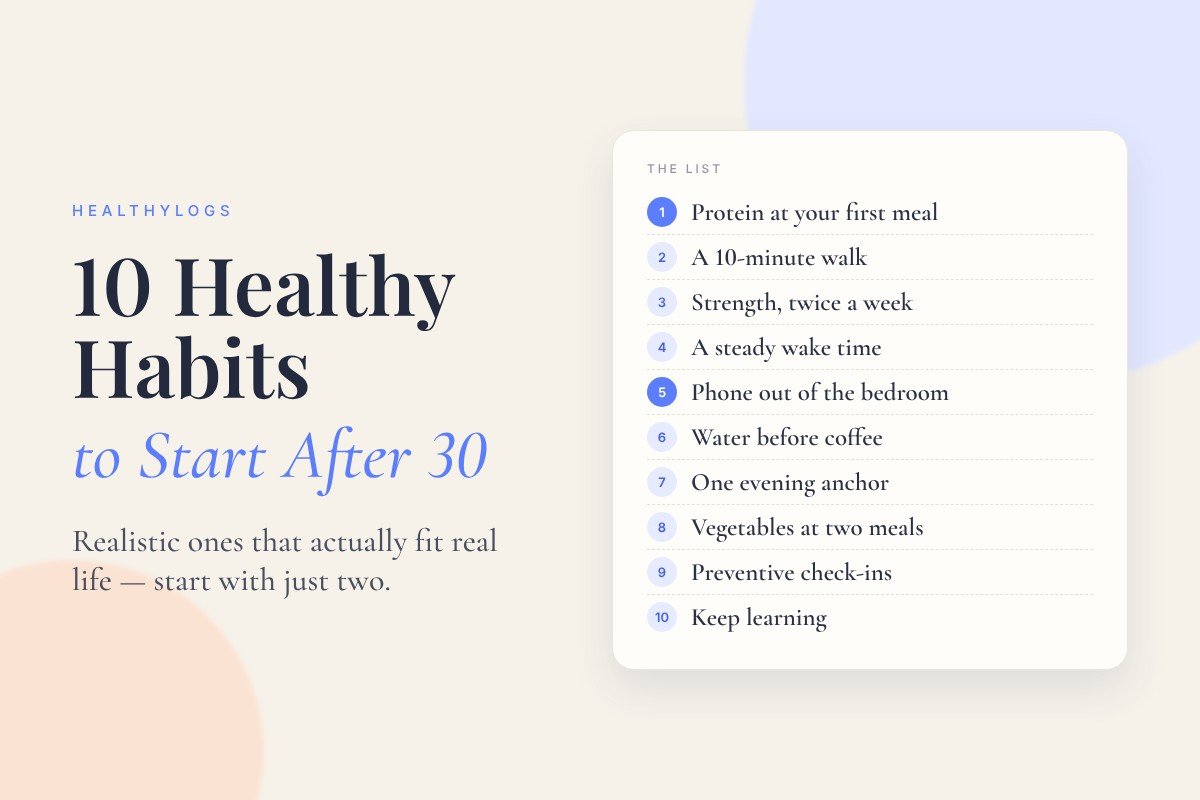
10 healthy habits to start after 30
Each habit below has three parts:
What it is. Why it matters. The smallest version you can start this week.
1. Include protein in your first meal
You do not need a complicated high-protein breakfast.
Start by including a protein source in the first meal you already eat.
That could be:
- Eggs
- Greek yogurt
- Cottage cheese
- Tofu
- Leftovers from dinner
- A protein shake when you're short on time
The recommended dietary allowance for protein for healthy adults is 0.8 g per kilogram of body weight per day. That figure represents a baseline requirement, rather than necessarily an optimal intake for every person or activity level.
Protein needs can vary depending on factors such as age, body size, health status, and physical activity.
So instead of turning breakfast into another number to hit, start with something much simpler:
Add one protein source to the breakfast you already eat.
If you normally have toast, add eggs.
If you usually grab something quickly, keep yogurt available.
The point is not to redesign your diet overnight.
It is to make a better choice easier.
2. Walk every day, even for 10 minutes
Walking is one of the easiest ways to add more movement to your day.
But you do not need to make 10,000 steps your daily pass-or-fail score.
Try setting a 10-minute floor instead.
Ten minutes is the minimum you can do on a difficult day. If you have more time, walk longer.
A walk after lunch, after your last meeting, or after dinner can all work.
The important part is choosing a trigger that already exists in your day.
The goal is not 10 minutes. The goal is making movement easy enough to happen regularly.
Read more: Why You Don't Need 10,000 Steps: A 10-Minute Walking Habit for Women Over 30
3. Strength train twice a week
Walking is useful, but it does not replace resistance training.
Adults benefit from muscle-strengthening activities as part of a regular physical activity routine, and maintaining muscle becomes increasingly relevant as we age.
Strength training does not have to mean joining a gym.
You can start at home with:
- Squats
- Hip hinges
- Wall or counter push-ups
- Resistance-band rows
- Lunges or split squats
Start with two short sessions a week.
Twenty minutes is enough to begin.
The most useful workout is not necessarily the most impressive one.
It is the one you can realistically repeat.
4. Keep a consistent wake time — not necessarily an early one
You do not need a 5 a.m. alarm to have a healthy morning routine.
A more useful starting point is to keep your wake time reasonably consistent.
That does not mean you need to wake at exactly the same minute every day. It means avoiding a large swing between your weekday and weekend schedule when possible.
Sleep regularity has been associated with health outcomes in observational research, although these findings do not prove that regularity itself causes better health.
The practical takeaway is simple:
Choose a wake time that fits your actual life. Then try to keep it reasonably consistent.
A realistic 7 a.m. wake time that you can maintain is more useful than a 5 a.m. routine you abandon after two weeks.
5. Keep your phone out of the bedroom
This is less about willpower and more about changing your environment.
If your phone is beside your pillow, checking it requires almost no effort.
If it charges in another room, scrolling in bed suddenly requires a decision.
Try using a simple alarm clock and giving your phone a permanent charging spot outside the bedroom.
You do not need a complicated nighttime routine.
Sometimes changing the environment does more than adding another rule.
6. Drink water before your first coffee
Have a glass of water before your first coffee if that helps you start the day with fluids.
But this habit needs one important clarification:
Water before coffee is not a special health hack.
There is no need to treat coffee as something you have to “detox” from or compensate for.
If you already drink enough fluids throughout the day, the exact order matters much less than the overall pattern.
This habit is here because it is simple, inexpensive, and easy to remember.
Put a glass near the kettle.
Drink it if you want to.
Then have your coffee.
7. Create one evening anchor
Forget the perfect 12-step nighttime routine.
Choose one small action that tells your brain the day is winding down.
It could be:
- Making tea
- Taking a shower
- Reading a few pages
- Turning off the main lights
- Writing tomorrow's top priority
The important part is not what you choose.
It is that the same action happens regularly enough to become familiar.
Think of it as an evening anchor, not a complete routine.
One habit you actually repeat is more useful than a perfect routine you abandon.
8. Put vegetables into two meals a day
You do not need to follow a complicated “clean eating” plan to eat more plants.
Start with one simple floor:
Add a vegetable to lunch and dinner.
Fresh, frozen, canned, bagged — all count.
Add frozen vegetables to a stir-fry.
Put salad beside your lunch.
Keep something easy to cook in the freezer.
This is not about eating perfectly.
It is about making vegetables a normal part of two meals.
9. Have regular preventive health check-ins
Healthy habits are not only about what you eat or how much you exercise.
Preventive healthcare belongs on the list too.
The right schedule for check-ups, screenings, vaccinations, and blood tests depends on your age, health history, risk factors, and where you live.
So instead of treating “one doctor visit a year” as a universal rule, use a better habit:
Know which preventive care is appropriate for you and keep up with it.
If something feels wrong, do not try to diagnose it through a wellness article.
Get it checked.
10. Keep learning something
Health is not only physical.
Keeping your mind engaged can be part of a healthy, meaningful life as you get older.
You do not need to start five courses at once.
Choose one thing you genuinely want to learn:
- A language
- A professional skill
- A certification
- An instrument
- A subject you've always been curious about
Give it a regular place in your week.
The goal is not productivity for its own sake.
It is staying curious.
How to pick two habits to start with
This is probably the most important part of the entire list.
Do not start all ten at once.
Ten habits are a project.
Projects require planning, motivation, and constant attention.
Instead, pick two.
A simple way to choose is to pick one habit that changes your environment and one that changes what you do.
Start with an environment habit
Choose from:
- Phone out of the bedroom
- Water before coffee
- One evening anchor
These require relatively little ongoing decision-making.
Then choose a body habit
Choose from:
- Protein at your first meal
- A daily walk
- Strength training twice a week
Pick the one you are least likely to resist.
Not the one that sounds the most impressive.
If you hate running, walking is fine.
If you dislike gyms, train at home.
If breakfast is difficult, start by adding protein to whatever meal you already eat first.
The best healthy habit is the one that fits your actual life.
Give your two habits some time before adding a third.
You are not trying to become a completely different person in seven days.
You are building a life where healthier choices become easier to repeat.
What about the habits you don't keep?
You will probably start something and stop.
That is normal.
A habit does not need a perfect streak to be useful.
The more useful question is:
Can I restart it without making the restart a big event?
Missed your walk yesterday?
Walk today.
Forgot the vegetables at lunch?
Add them at dinner.
Used your phone in bed?
Put it outside the bedroom tonight.
A sustainable habit is not one you never break.
It is one you know how to return to.
Frequently asked questions
What healthy habits should I start in my 30s?
Start with two habits rather than trying to change everything at once.
A practical combination is one environmental habit, such as keeping your phone out of the bedroom, and one movement or nutrition habit, such as walking regularly or adding protein to your first meal.
Once those feel established, add another.
Is 35 too late to get healthy?
No.
There is no age at which healthy habits suddenly stop being worthwhile.
Strength training, regular movement, nutritious food, adequate sleep, and preventive healthcare remain relevant throughout adulthood.
Your starting point may change over time, but starting still matters.
How long does it take for a new habit to stick?
There is no universal number.
A frequently cited study found an average of around 66 days for a behavior to become more automatic, with substantial variation between people and habits.
So instead of expecting a habit to become automatic in 21 days, give yourself more time.
And judge progress by whether the habit survives an ordinary, difficult week — not just by whether you maintained a perfect streak.
What should women over 30 eat for breakfast?
There is no single breakfast that every woman over 30 needs to eat.
A useful starting point is to include a source of protein and build the rest of the meal around your preferences, appetite, culture, schedule, and nutritional needs.
Eggs, yogurt, cottage cheese, tofu, leftovers, or a protein shake can all work.
The goal is not a “perfect” breakfast.
It is a breakfast that works for you consistently.
HealthyLogs shares practical wellness information based on research and lived experience. This article is for general education and is not medical advice. Individual nutritional, exercise, screening, and healthcare needs vary. Speak with a qualified healthcare professional for advice specific to you.
Sources
- National Research Council — Recommended Dietary Allowances, 10th edition (1989)
- World Health Organization — Guidelines on physical activity and sedentary behaviour (2020)
- Windred DP et al. — Sleep regularity is a stronger predictor of mortality risk than sleep duration. SLEEP, 2024
- Lally P et al. — How are habits formed: modelling habit formation in the real world. European Journal of Social Psychology, 2010