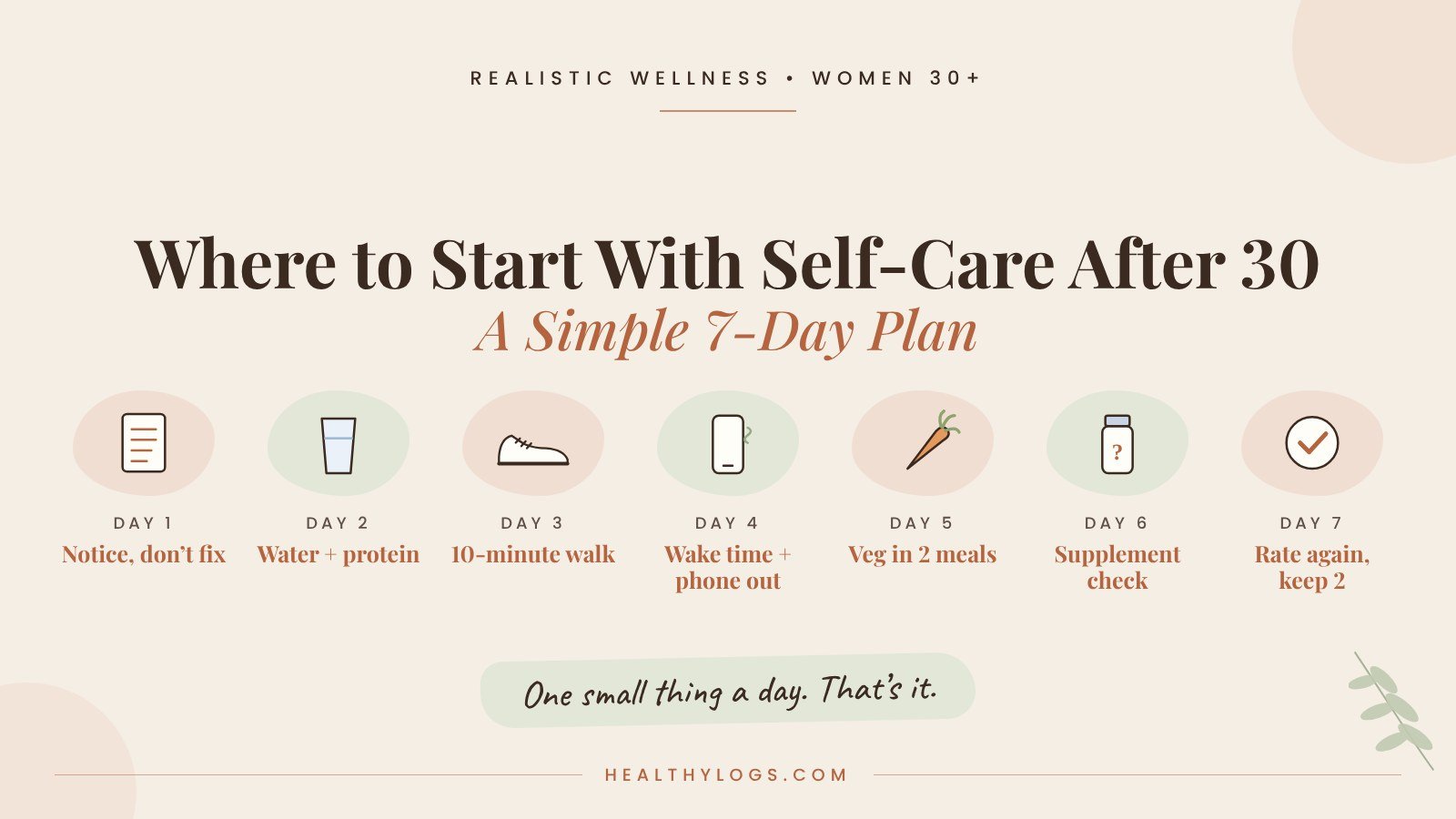
If you don't know where to start with self-care, start smaller than you think. For the next seven days, add one small thing a day. And on day one, don't change anything at all. Just notice how you feel.
That's the whole plan. No 5am alarm, no new wardrobe, no shelf full of supplements.
Why starting small works better after 30
Most of us don't fail at healthy habits because we're lazy. We fail because we start ten things on a Monday and drop all ten by Friday.
Habits take time. In one well-known study, it took people about 66 days on average for a new behavior to feel automatic, and the range was huge [4].
So week one isn't about results. It's about proving to yourself that you can start.
Your 7-day self-care plan
Each day adds one thing. Keep the earlier days if they feel easy. On a hectic day, do the smallest version and call it a win.
Day 1: Notice, don't fix
Tonight, rate four things from 1 to 5: sleep, energy, digestion, and mood. Write the numbers down. That's it.
Smallest version: rate your energy only.
Why it matters: you can't see progress without a starting point.
Day 2: Water before coffee, protein at breakfast
Drink a glass of water before your first coffee. Then add one protein to the breakfast you already eat: eggs, Greek yogurt, cottage cheese, tofu, or last night's leftovers.
Smallest version: just the water. Leave the glass next to the coffee maker tonight.
Day 3: A 10-minute walk after a meal
Walk for 10 minutes after lunch, after work, or after dinner. Pick a moment that already exists in your day.
The World Health Organization notes that some physical activity is better than none [1]. Ten minutes counts.
Smallest version: walk for 5 minutes, or walk during one phone call.
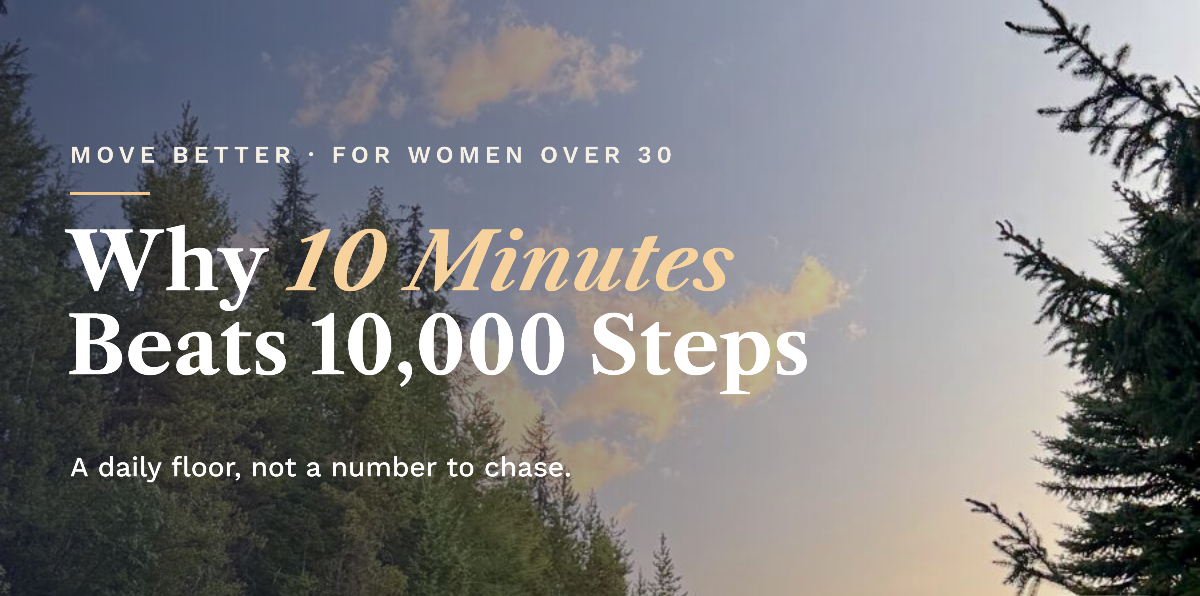
Read more: Why You Don't Need 10,000 Steps: A 10-Minute Walking Habit for Women Over 30
Day 4: Pick a wake time and move your phone
Choose one wake time you can keep all week. 7am is fine. Tonight, charge your phone outside the bedroom.
Adults are advised to get 7 or more hours of sleep a night [2], and a regular sleep schedule has been linked with better health in observational research [3].
Smallest version: phone face-down across the room.
Day 5: Add a vegetable to two meals
One at lunch, one at dinner. Fresh, frozen, canned, or bagged all count. This is about adding, not cutting. Nothing is off-limits.
Smallest version: a handful of frozen veggies stirred into whatever you're already making.
Day 6: Check your supplements (don't buy anything)
Before you add a supplement, ask yourself five questions:
-
What exact problem am I trying to solve?
-
Have I tried the food or habit version first?
-
Do I actually know I'm low? If not, ask your doctor whether a blood test makes sense.
-
Could it interact with my medications or a health condition?
-
Is it third-party tested? Look for a USP, NSF, or ConsumerLab seal.
Why this matters: supplements don't need FDA approval before they're sold, and some can interact with medicines [5][6]. A third-party seal means the product contains what the label says. It doesn't mean it's safe or right for you.
Who this isn't for: if you're pregnant, breastfeeding, taking prescription medication, or have surgery coming up, talk to your doctor or pharmacist before starting any supplement [5].
Day 7: Rate again, keep two
Rate the same four things from Day 1. Then circle the two habits that felt easiest. Keep those. Let the rest go, no guilt.
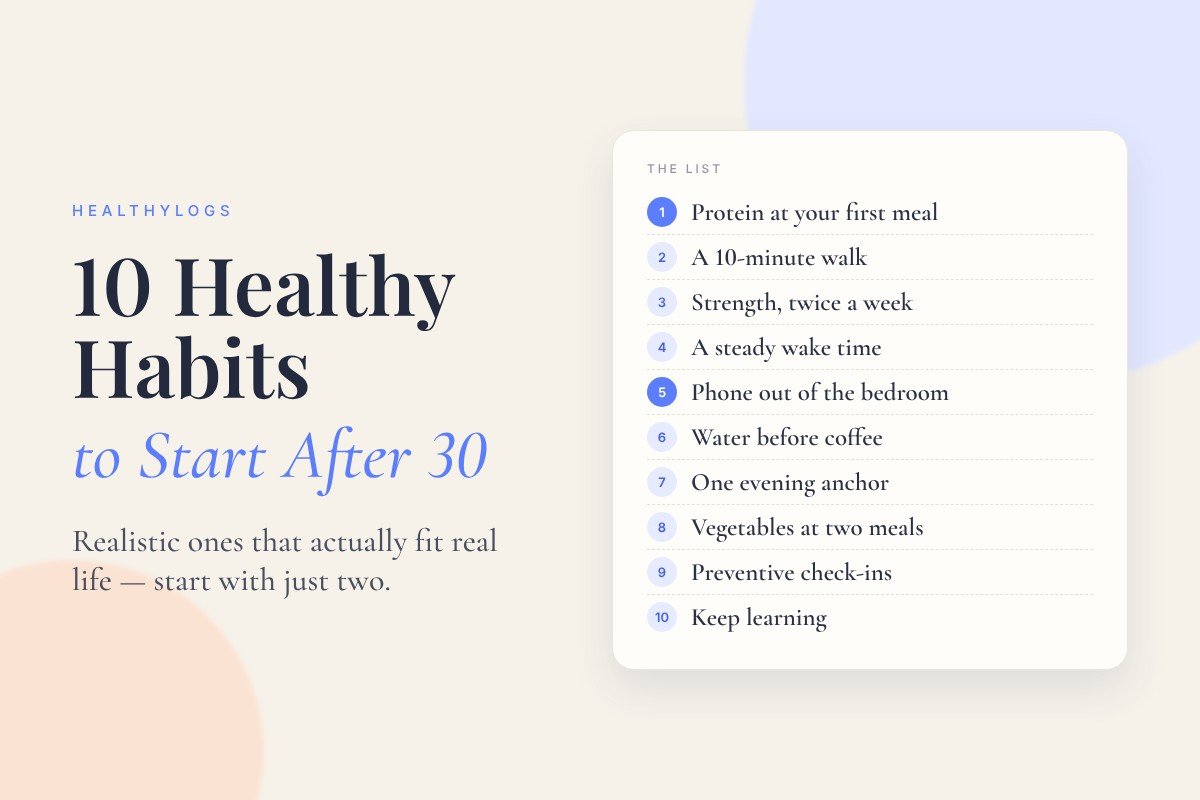
Two habits you keep beat seven you abandon. It's the same rule I use in 10 Healthy Habits to Start After 30.
What comes after week one
Week 2, add two short strength sessions at home. Week 3, protect your sleep with one evening wind-down habit. Week 4, look for real gaps, and only then decide whether you need a supplement.
One layer at a time. That's how self-care starts to stick.
Get the 7-day plan on one page
Want this plan as a printable checklist with the daily rating chart? Join the free healthylogs email list and I'll send you the Start Here 7-Day Plan, plus what to add in weeks 2 to 4.
FAQ
What is the first step of self-care?
Notice before you change. Rate your sleep, energy, digestion, and mood for one day so you know where you're starting.
Do I need supplements to start taking care of myself?
No. Start with sleep, movement, and food. If a specific gap shows up, talk to your doctor before adding a supplement.
What if I miss a day?
Do that day's step tomorrow. This plan still works if it takes you ten days.
This article is for general education and is not medical advice. Talk with a qualified healthcare professional about your own needs.
Sources
- World Health Organization — Guidelines on physical activity and sedentary behaviour (2020)
- Watson NF et al. — Recommended amount of sleep for a healthy adult: AASM/SRS consensus statement (2015)
- Windred DP et al. — Sleep regularity is a stronger predictor of mortality risk than sleep duration. SLEEP, 2024
- Lally P et al. — How are habits formed: modelling habit formation in the real world. European Journal of Social Psychology, 2010
- NIH Office of Dietary Supplements — Dietary Supplements: What You Need to Know
- U.S. Food and Drug Administration — Dietary Supplements