
In Ayurveda and in Chinese wellness traditions, the day starts warm: a cup of warm water before anything cold, sweet or caffeinated. It's one of the simplest rituals you can borrow. Below are five versions, how much of each to use, and what modern research says they may do.
Why start warm? The Eastern idea
In Ayurveda, warm water in the morning is said to gently wake up agni, the body's "digestive fire." In Chinese yangsheng, the stomach is seen as preferring warmth, so a warm drink is a kinder first sip than ice water. Many Vietnamese, Chinese and Indian families still start the day this way.
Modern science adds a simple reason: after a long night without fluid, a glass first thing helps you top up. In one small study of healthy young women, mild dehydration (about 1.4% of body weight) was linked to lower mood, more fatigue and headaches [1].
Our take: the tradition and the research meet in the same place. Warm water is the foundation; lemon, ginger and honey are gentle add-ins with a little science behind each.
The golden rule: warm, not hot
Aim for about 50–60°C (122–140°F): warm enough to feel cozy, cool enough to sip right away. Drinks above 65°C (149°F) are linked to a higher risk of esophageal cancer [2], so if it's steaming hard, give it a few minutes.
The 5 warm morning drinks
1. Warm water: the foundation
How much: 1–2 cups (250–500 ml), sipped slowly over 5–10 minutes.
The Eastern meaning: often called the first medicine of the day, a calm signal to your body that the day has started.
What research says: it rehydrates you after the night [1], and everything else on this list builds on it.
2. Warm lemon water: the brightener
How much: juice of ½ lemon (about 1½ tablespoons / 20–25 ml) in 1 cup of warm water, once a day.
The Eastern meaning: in Ayurveda, sour taste is said to awaken the appetite and digestion, a fresh start for the senses.
What research says: half a lemon gives roughly 9 mg of vitamin C, about an eighth of the 75 mg women need daily [3][4]. Your body uses vitamin C to make collagen, the protein that supports skin [3], so it's a small, daily helper for your glow. It also makes water more inviting to drink.
Gentle tip: sip through a straw and rinse with plain water after, then wait 30 minutes to brush [5]. Your enamel will thank you.
3. Warm ginger water: the warmer
How much: 3–4 thin slices of fresh ginger (about a 1-inch / 2–3 cm piece) steeped in 1 cup of hot water for 5–10 minutes, then cooled to warm. 1–2 cups a day.
The Eastern meaning: Ayurveda calls ginger vishwabheshaj, the "universal medicine." In Chinese cooking and yangsheng, fresh ginger is the classic way to warm the body on cold mornings and settle the stomach.
What research says: a review of 109 clinical trials found ginger most consistently helps with nausea, and studies suggest it may ease period cramps [6][7]. Most trials used capsules (about 0.5–1.5 g a day), so a cup is a gentler, everyday dose.
Gentle tip: lovely during your period week or on chilly mornings. Add a squeeze of lemon if you like it brighter.
4. Warm honey water: the soother
How much: 1 teaspoon of honey (about 7 g) in 1 cup of warm water. Keep to 1–2 teaspoons a day.
The Eastern meaning: Ayurveda prizes honey but advises never cooking it or stirring it into boiling water. Let the water cool to warm first, which matches the golden rule above.
What research says: a review of 14 trials found honey eased cough frequency and severity during colds better than usual care [8]. Honey counts as added sugar, and 1–2 teaspoons fits comfortably within the American Heart Association's 25 g daily guide for women [9].
5. Warm lemon and honey water: the comforter
How much: juice of ½ lemon + 1 teaspoon of honey in 1 cup of warm water.
The Eastern meaning: in Vietnamese homes, chanh mật ong (simply "lemon honey") is the go-to drink at the first sign of a scratchy throat, often with a slice of ginger added.
What research says: honey soothes, lemon adds vitamin C and flavor. A cozy choice for cold-season mornings.
Your quick guide
| Drink | How much | Best for |
|---|---|---|
| Warm water | 1–2 cups (250–500 ml) | Every morning |
| Lemon | ½ lemon in 1 cup | A fresh start, a little vitamin C |
| Ginger | 3–4 slices, 1–2 cups/day | Cold mornings, period week, queasy days |
| Honey | 1 tsp, max 1–2 tsp/day | Scratchy throat, cold season |
| Lemon + honey | ½ lemon + 1 tsp | First sign of a sore throat |
Sip it slowly, then have your coffee or tea. If you want one more small step, a 10-minute walk pairs well.
Make it work for your body
These rituals are gentle, but a few adjustments help:
- Prone to heartburn or reflux? Start with plain warm water and go easy on lemon and ginger.
- Pregnant, on blood thinners or other daily medication? Ask your doctor before drinking ginger every day [7].
- Managing blood sugar? Check with your doctor before adding honey. And never give honey to babies under 1 [10].
- Lemon is for drinking. Keep the juice off sun-exposed skin, where it can cause a burn-like rash [11].
What I tried
Warm water first thing has become a habit I can't go without. On slower mornings, I squeeze in some lemon and drop a slice into my water bottle to sip through the day. On cold days, or during my period, I add a few slices of ginger. It's a small ritual, but it's the one my mornings are built around.
Want more small rituals like this?
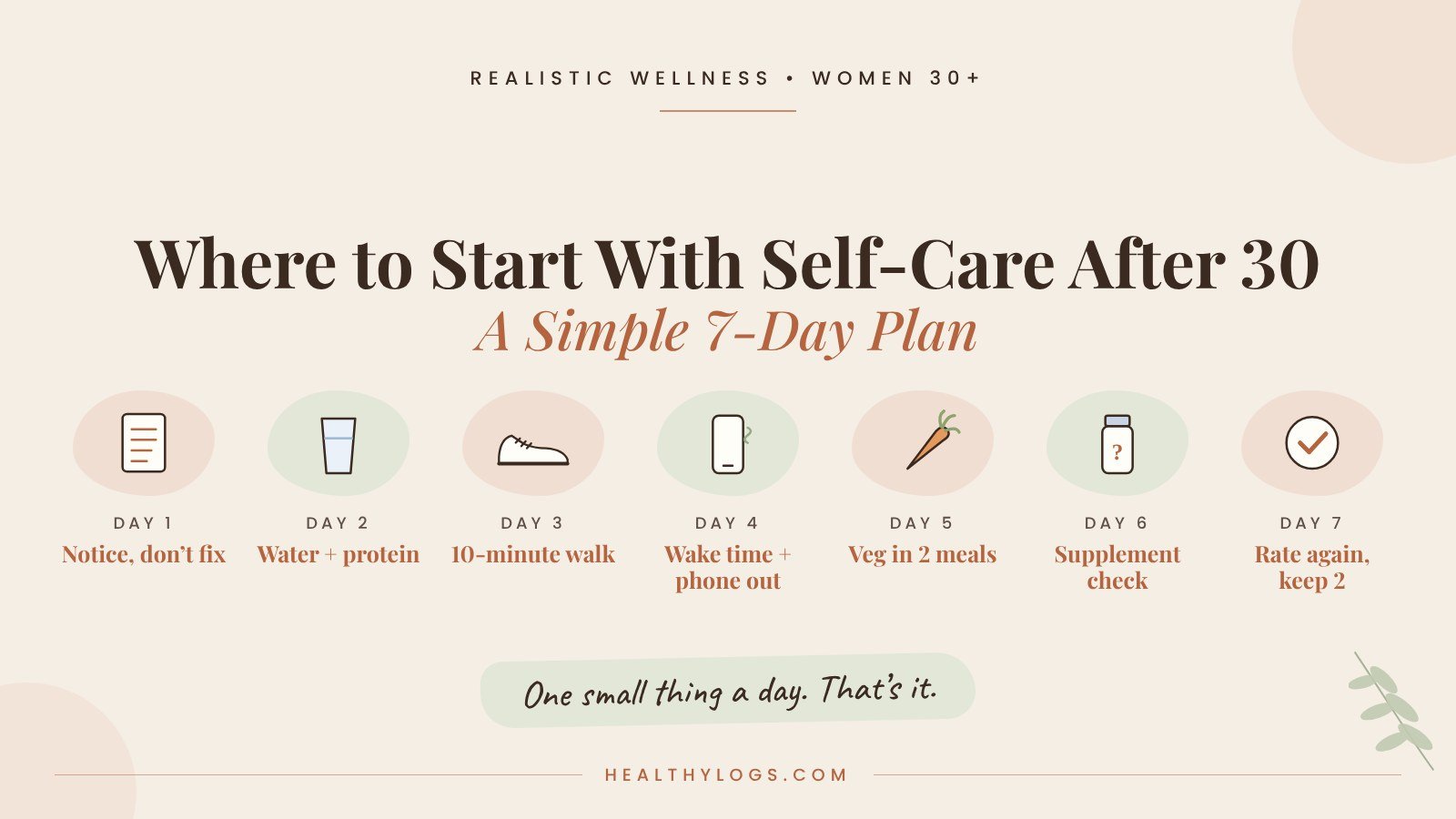
A warm glass before coffee is Day 2 of my free Start Here 7-Day Plan: one small, realistic step a day for women who don't know where to start. Get the plan and start tomorrow.
FAQ
When is the best time to drink it?
Within 30 minutes of waking, before coffee or breakfast. That's when the ritual feels most natural.
Can I drink warm lemon water every day?
Yes. Half a lemon a day is a common, comfortable amount. Use a straw and rinse after to protect your teeth.
Can I mix them?
Absolutely. Lemon-ginger and lemon-honey-ginger are favorites. Just keep the honey to 1–2 teaspoons a day.
This article is for general information and isn't medical advice. If you're pregnant, take medication or have a health condition, check with your doctor before changing what you drink.
The weekly log
One small habit, every week
- One realistic habit I'm trying, and how it actually went
- The research behind it, in plain English
- A two-minute read. No spam, no pressure to buy
Free. Unsubscribe anytime.
Sources
- Armstrong LE et al. Mild dehydration affects mood in healthy young women. J Nutr. 2012;142(2):382–388. doi.org/10.3945/jn.111.142000
- IARC (WHO). Press release 244: IARC Monographs evaluate drinking coffee, maté, and very hot beverages. 2016. iarc.who.int
- NIH Office of Dietary Supplements. Vitamin C – fact sheet for consumers. ods.od.nih.gov
- USDA National Agricultural Library. Vitamin C content of selected foods. nal.usda.gov
- Delta Dental of Iowa. Lemon water and dental health. deltadentalia.com
- Anh NH et al. Ginger on human health: a comprehensive systematic review of 109 randomized controlled trials. Nutrients. 2020;12(1):157. pmc.ncbi.nlm.nih.gov
- NIH National Center for Complementary and Integrative Health (NCCIH). Ginger: usefulness and safety. nccih.nih.gov
- Abuelgasim H, Albury C, Lee J. Effectiveness of honey for symptomatic relief in upper respiratory tract infections: a systematic review and meta-analysis. BMJ Evid Based Med. 2021;26(2):57–64. ebm.bmj.com
- American Heart Association. How much sugar is too much? heart.org
- University of Florida IFAS Extension. Honey and infant botulism (EDIS AA142). edis.ifas.ufl.edu
- National Capital Poison Center. Lime juice and sun can cause skin rashes. poison.org