You wake up, reach for your phone, and 20 minutes later you've read three emails, two news alerts and someone's vacation photos. Your brain feels tired, and you haven't even had breakfast.
Brain stacking is the TikTok trend that flips this. Instead of scrolling, you stack two or three small, phone-free activities: a few pages of a book, a quick puzzle, three lines in a notebook. For women in their 30s and 40s, a gentle 15-minute version may be one of the easiest ways to start the day with your own thoughts first.
What brain stacking is (and isn't)
It is a short routine of small things that use your brain in different ways. Read. Solve. Write. Usually in the morning, usually with a warm drink.
It isn't a brain-training program, a productivity hack or a reason to set a 5 a.m. alarm.
What the science actually says
No one has studied brain stacking as a full routine yet. Here's the short, honest version:
- Staying mentally active matters. The 2024 Lancet Commission on dementia says "cognitively stimulating activities in midlife also protect cognition" (Livingston et al., 2024).
- Puzzles won't make you a genius. Brain-training games mostly make you better at the game itself, with "very little evidence" for everyday thinking (Simons et al., 2016). So pick puzzles you actually enjoy.
- The real win may be the swap. Fifteen minutes you chose replaces fifteen minutes of everyone else's noise.
Why this matters after 30
- Brain fog can show up earlier than you'd expect. Perimenopause usually begins in your 40s, but some women notice changes in their 30s (Mayo Clinic). The NHS lists poor memory and brain fog among the symptoms (NHS).
- Midlife habits count. The same Lancet report says it's "never too early or too late" to look after your brain.
That's not a reason to worry. It's a reason to give your brain a calm start.
3 brain stacks to try this week
The 5-minute stack (for chaotic mornings)
- Read one page of a book.
- Write one line: "Today I want to feel…"
The 15-minute stack (the classic)
- 5 minutes reading
- 5 minutes on one puzzle: sudoku, a crossword or a word search
- 5 minutes writing three lines: how I feel, one thing that matters today, one thing I can let go of
The 30-minute weekend stack
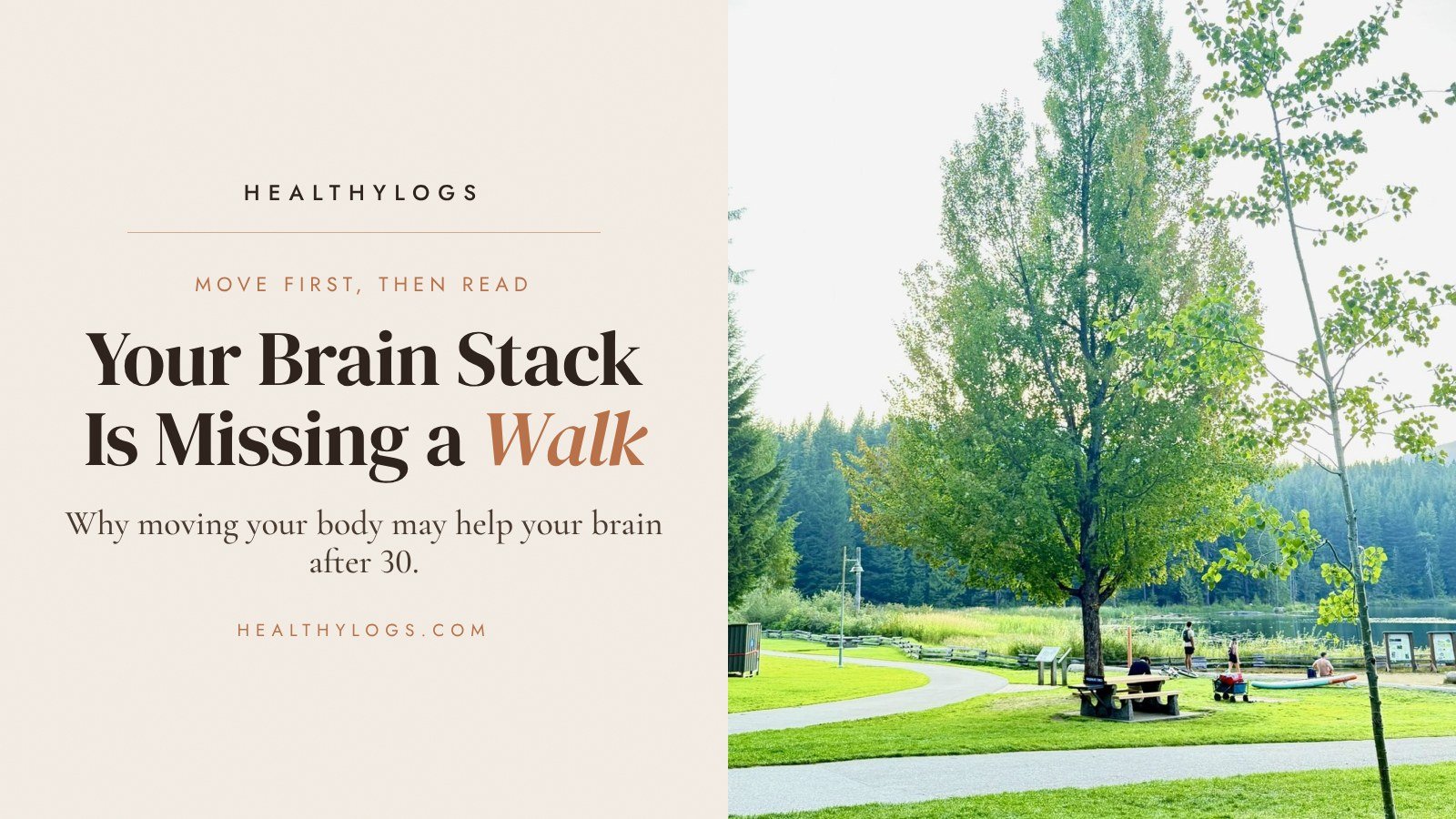
- A 10-minute walk outside (here's why the walk counts)
- 10 minutes reading
- 10 minutes writing or doodling
4 rules that make it stick
- Attach it to something you already do. "After I pour my warm water, I open my book." In a review of 94 tests, if-then plans like this had a medium-to-large effect on reaching goals (Gollwitzer & Sheeran, 2006).
- Set it up the night before. Book on the table, puzzle page folded, pen on top. When it's already there, there's nothing to decide.
- Put your phone in another room. Not face down. Another room. It's one of the realistic habits that makes everything else easier.
- Stop while it's still fun. After 30, many mornings are already full of other people's needs: work, kids, parents. A stack you can finish in 5 minutes is the one you'll keep.
Build your own stack
Pick one thing from two or three of these:
- Read: a novel, a poem, one chapter of a nonfiction book
- Solve: sudoku, a crossword, a word search, a chess puzzle
- Write: three lines, a to-do brain dump, one thing you're grateful for
- Move: a 10-minute walk, a few stretches or gentle Eastern warm-up moves by the window
What I tried
My own brain stack starts with my feet. I walk first, then listen to a podcast or a few affirmations, and I feel better after it. Some mornings I'm lazier, so I don't force the walk right away. I read a few pages first, then do a few gentle Eastern warm-up exercises, to warm up my body before I head outside.
Know your why first
A brain stack is easier to keep when you know why you're doing it. Get the free Find Your Wellness Why worksheet: 10 questions to find the reason that keeps you going.
Free · 15-minute worksheet · 6 pages
Get the free Find Your Wellness Why worksheet
Go from a surface goal to a reason you can feel on a normal Tuesday, then match it with one gentle habit.
Free. You'll also get one short, honest email a week. Unsubscribe anytime.
FAQ
Is brain stacking backed by science?
Not as a full routine. Staying mentally active is linked to better brain health, but most of that evidence is observational, and puzzle games mainly train the puzzle.
Is it too late to start at 40?
No. The Lancet Commission says it's never too early or too late to look after your brain.
Can I do it at night instead?
Yes. Any calm 15 minutes works. Just keep the phone in another room.
This article is for general education and is not medical advice. If changes in your memory or focus worry you, talk to a qualified healthcare professional.
Sources
- Livingston G et al. — Dementia prevention, intervention, and care: 2024 report of the Lancet standing Commission. The Lancet, 2024
- Simons DJ et al. — Do "brain-training" programs work? Psychological Science in the Public Interest, 2016
- Mayo Clinic — Perimenopause: symptoms and causes
- NHS — Menopause: symptoms
- Gollwitzer PM, Sheeran P — Implementation intentions and goal achievement: a meta-analysis. Advances in Experimental Social Psychology, 2006