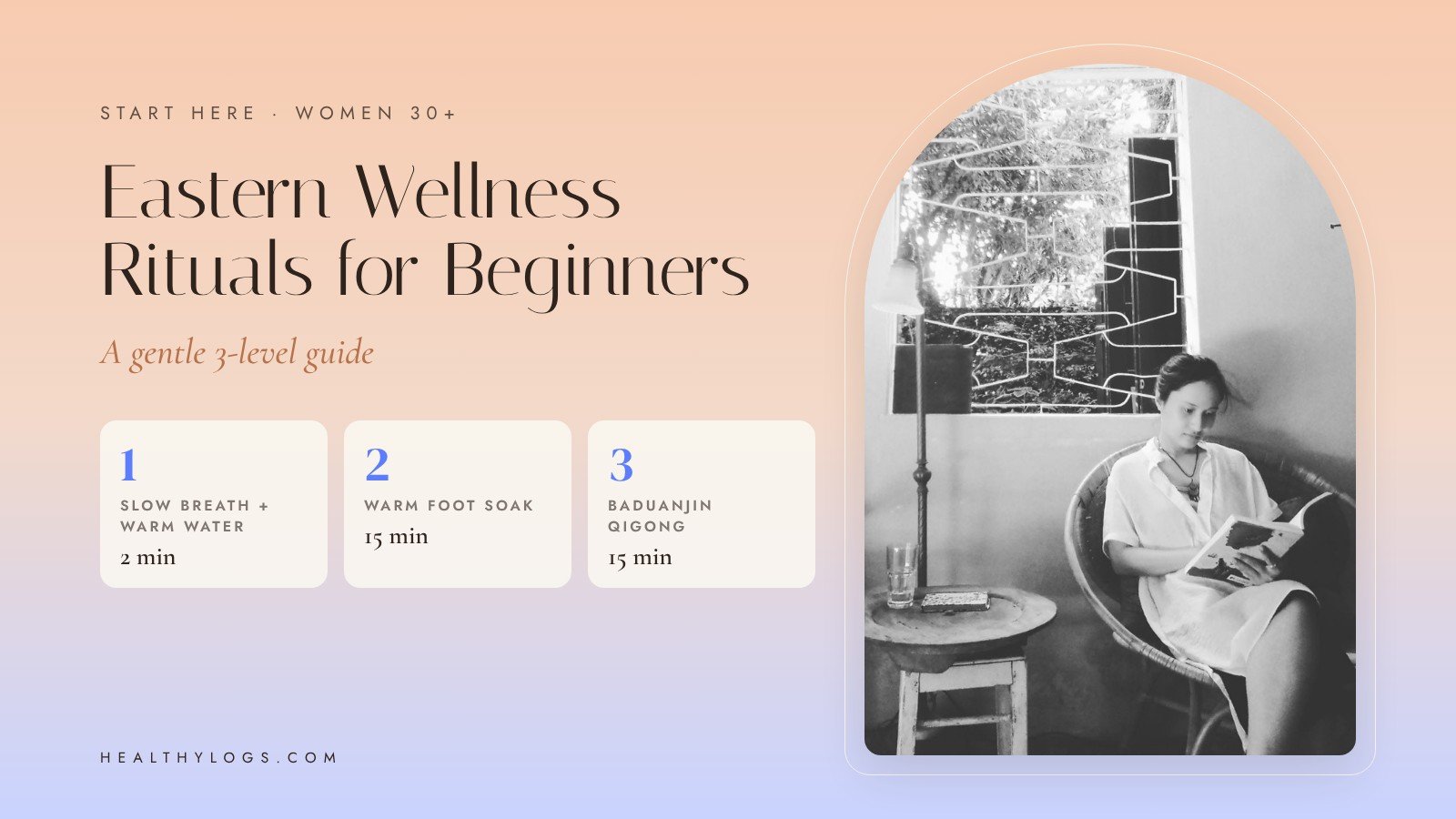
If Ayurveda and Chinese wellness sound lovely but overwhelming, start smaller than you think. Pick Level 1, do it for two weeks, then move up. Each level below shows what the tradition says and what research actually shows.
Why rituals, not rules
Ayurveda calls the daily routine dinacharya. Chinese tradition calls it yangsheng, nourishing life. Neither asks for perfection, just small things done at about the same time each day. With a full calendar in your 30s or 40s, a 2-minute ritual survives a busy week. A 20-step routine doesn't.
Level 1 · 2 minutes, every morning
Breathe slowly for 2 minutes
Tradition: Ayurveda and yoga call breath control pranayama. Prana means both breath and life energy.
Research: breathing under 10 times a minute nudges your nervous system toward its calmer "rest and digest" side [2]. A meta-analysis of 12 randomized trials with 785 adults linked breathwork, mostly slow-paced, with lower stress. The effect was small to moderate [1].
How: sit on the edge of your bed before you touch your phone. Breathe in for 4 counts, out for 6. Do 12 rounds, about 2 minutes. Feel dizzy? Go back to normal breathing.
Drink warm water before coffee
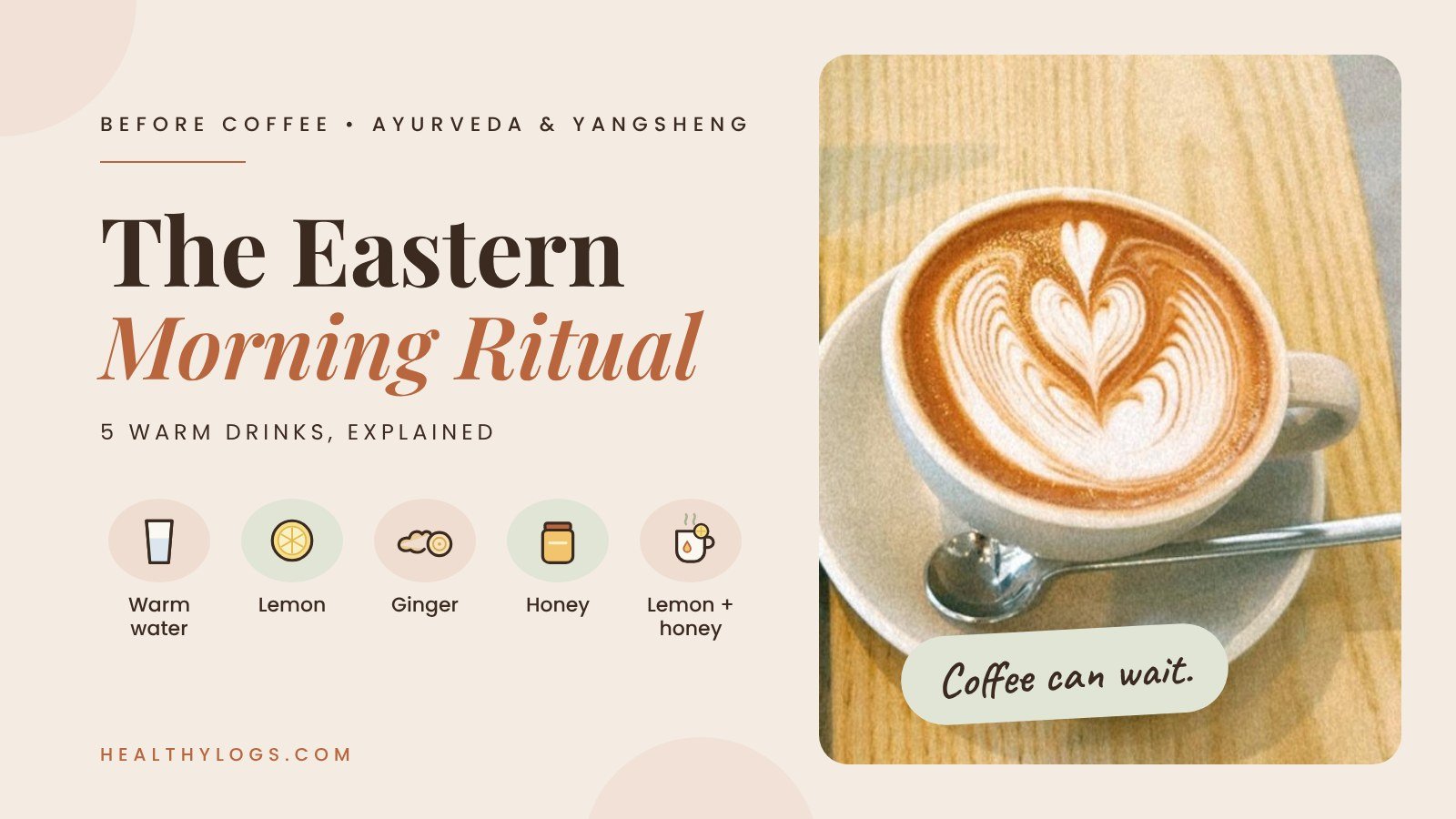
One cup, warm not hot, before anything cold or caffeinated. Ayurveda and Chinese wellness both start the day this way, and after a night without fluids, it's an easy first sip. Lemon, ginger and honey versions are in Start Your Day Warm.
Move up when: you've done both on 10 of 14 mornings.
Level 2 · 15 minutes, in the evening
Soak your feet in warm water
Tradition: a Chinese saying goes, "cold enters from the feet." A nightly foot soak is common in Chinese and Vietnamese homes.
Research: your core temperature drops before sleep. Warm water sends blood to your feet, where heat escapes, which helps that drop. A meta-analysis of 17 studies found that warm baths or foot baths at 40 to 42.5°C (104 to 108.5°F), 1 to 2 hours before bed, helped people fall asleep faster [3]. A small study of 9 women aged 21 to 40 found the same for a hot foot bath [4].
How: 1 to 2 hours before bed, soak ankles or calves in water around 40°C (104°F) for 10 to 15 minutes. Test it with your elbow, then dry your feet and put on socks.
Who this isn’t for
If you have diabetes, numb feet or poor circulation, it's easy to burn skin you can't fully feel, so check with your doctor first. Pregnant? Ask your doctor too.
Level 3 · 15 minutes, gentle movement
Learn Baduanjin, the "Eight Pieces of Brocade"
Tradition: a Chinese qigong set of eight slow movements paired with breathing, so your Level 1 breath comes with you.
Research: in a trial of 87 women aged 35 to 60, 12 weeks of Baduanjin helped maintain bone density compared with no exercise [5]. A 2026 meta-analysis of 18 trials in adults over 60 found better sleep and stronger grip, though many studies were small [6]. Muscle matters too, as explained in Why Muscle Matters More After 35.
How: learn the first 2 movements from a qigong teacher's video, then add one a week. The full set takes about 10 to 15 minutes. Sore knee or back? Make each move smaller.
Log it: what to track
| Level | Track | Move up after |
|---|---|---|
| 1 | Mornings done, how calm you feel (1 to 5) | 10 of 14 mornings |
| 2 | Rough minutes to fall asleep, how you wake (1 to 5) | 10 of 14 evenings |
| 3 | Sessions per week, stiffness (1 to 5) | 4 weeks |
Our take: the evidence is small but consistent. Slow breathing and warm soaks show modest, short-term effects, and Baduanjin has more trials but uneven quality. Enough to try with curiosity, not enough to promise results.
What I tried
Here's my real routine right now. When I wake up, I do a few minutes of deep breathing, then drink a cup of warm water before anything else. After that comes Baduanjin, usually right after a gentle belly rub, another old Chinese wellness habit. Three nights a week, I soak my feet in warm water before bed. Not every night, and that still counts.
Your three lenses
Feel better · today. Before you check your phone tomorrow, take 12 slow breaths.
Move better · this week. Learn the first Baduanjin movement and do it 3 times.
Age well · the next 10 years. Small rituals kept for years shape sleep, bones and muscle more than any big plan you quit in March.
Not sure why you'd stick with a ritual past week two? The free Find Your Wellness Why worksheet helps you find your reason.
Free · 15-minute worksheet · 6 pages
Get the free Find Your Wellness Why worksheet
Go from a surface goal to a reason you can feel on a normal Tuesday, then match it with one gentle habit.
Free. You'll also get one short, honest email a week. Unsubscribe anytime.
FAQ
Do I need to follow Ayurveda or Chinese medicine fully?
No. Borrow one ritual without adopting a whole system.
Can I do all three levels at once?
You can, but habits tend to last longer when you add one at a time.
What if slow breathing makes me dizzy?
Return to normal breathing and try a gentler count, in for 4 and out for 5.
This article is for education only and isn't a substitute for medical advice. Talk to your doctor before starting something new if you have a health condition, are pregnant or take medication.
Sources
- Fincham GW, Strauss C, Montero-Marin J, Cavanagh K — Effect of breathwork on stress and mental health: a meta-analysis of randomised-controlled trials. Scientific Reports, 2023
- Zaccaro A et al. — How breath-control can change your life: a systematic review on psycho-physiological correlates of slow breathing. Frontiers in Human Neuroscience, 2018
- Haghayegh S et al. — Before-bedtime passive body heating by warm shower or bath to improve sleep: a systematic review and meta-analysis. Sleep Medicine Reviews, 2019
- Sung EJ, Tochihara Y — Effects of bathing and hot footbath on sleep in winter. Journal of Physiological Anthropology and Applied Human Science, 2000
- Chen HH, Yeh ML, Lee FY — The effects of Baduanjin qigong in the prevention of bone loss for middle-aged women. American Journal of Chinese Medicine, 2006
- Zhao L et al. — Effects of Baduanjin exercise on sleep quality, depressive symptoms, quality of life, and body composition in older adults: a systematic review and meta-analysis. Frontiers in Public Health, 2026