If you're a busy woman in your 30s or 40s, "healthy" probably sounds like an hour at the gym, a perfect diet and eight hours of sleep. It doesn't have to. For most of us, healthy means hitting a few minimums, most weeks, in whatever pockets of time you actually have.
Here are those four minimums, and the research that says they count.
Why "all or nothing" keeps you at nothing
When healthy means a 60-minute workout, one busy week turns it into zero. Then zero becomes the habit.
Here's the part most people missed: US activity guidelines dropped the old rule that exercise only counts in 10-minute blocks. Short bursts add up too.
Why this matters after 30
- Muscle. Adults naturally lose about 3–5% of muscle mass per decade starting around 30, especially when they're less active. Strength work is usually the first thing busy women drop.
- Sleep and hormones. Perimenopause usually begins in the mid-40s but can start earlier, and the anxiety it can bring may make sleep harder.
So these minimums aren't extras. They're the parts that protect you most in the decade ahead.
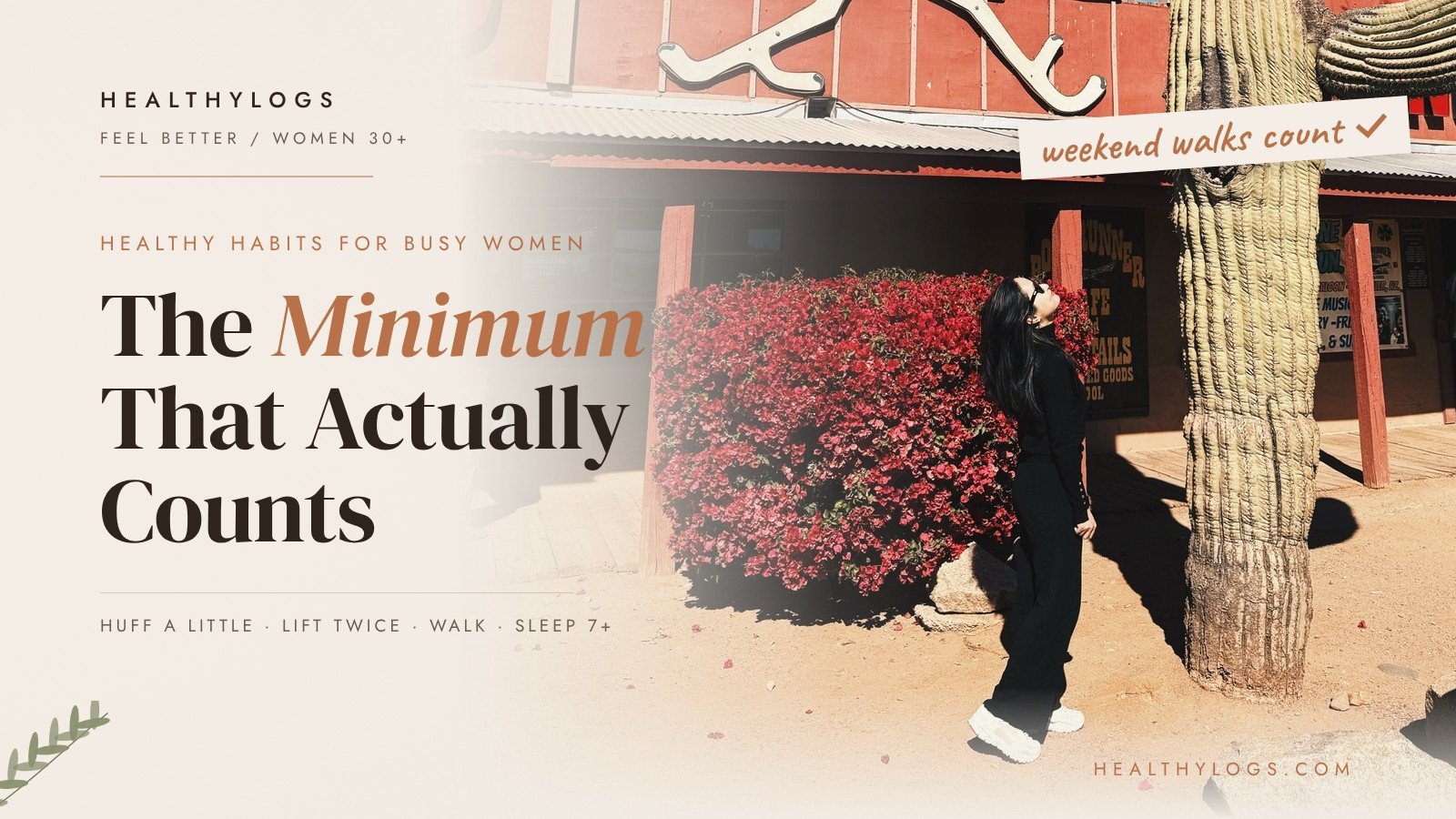
The 4 minimums that actually count
1. A few minutes of "huffing" a day
Take the stairs fast. Walk briskly to the train. Carry the groceries up in one trip. Anything that leaves you a little out of breath for a minute counts.
In a UK Biobank study of about 13,000 women who didn't exercise, those who did around 3.4 minutes a day of these short, vigorous everyday bursts had about 45% lower risk of major heart events than women who did none. Even 1 to 2 minutes a day was linked to lower risk. The women were middle-aged and older, and the study shows a link, not proof.
2. 150 minutes a week, any way it fits
Guidelines suggest 150 to 300 minutes of moderate activity a week, like brisk walking. That's the target. How you get there is up to you.
Can't fit 30 minutes in on weekdays? In a study of nearly 90,000 adults, people who packed most of their 150 minutes into one or two days had heart benefits similar to people who spread them out. A long walk on Saturday and Sunday counts. So does a 10-minute walk at lunch.
3. Two short strength sessions a week
The same guidelines recommend muscle-strengthening activity at least 2 days a week. Fifteen minutes is enough to start: squats, counter push-ups and a resistance band while the TV is on.
Why it matters
After 30, it's the one habit that directly works against the slow muscle loss that starts this decade.
4. A 7-hour sleep floor
Adults need 7 or more hours of sleep a night. On a busy week, protect your bedtime and wake time before anything else. A tired brain skips everything on this list.
Ayurveda has a word for a good daily routine: dinacharya. The idea is rhythm, not intensity. You wake, eat and rest at roughly the same times each day. That's a gentler goal than "optimize," and easier to keep in a full week.
What you can take off your list
- A 10,000-step target. It traces back to a 1960s pedometer, not a study (here's the story).
- A perfect diet. Better meals help, but you don't need an overhaul to start.
- A 12-step morning routine. One habit you keep beats five you drop.
What I tried
Between my work and building Healthylogs, most of my weeks are full. What helps is Ayurveda's idea of dinacharya: keep the same daily rhythm, even on long days. My walk to the market covers my moderate minutes. For strength, I use two small dumbbells at home, plus light gym sessions where my husband and friends are teaching me the machines. Some weeks I only hit two of the four minimums. I've stopped calling that a failure.
Your next step
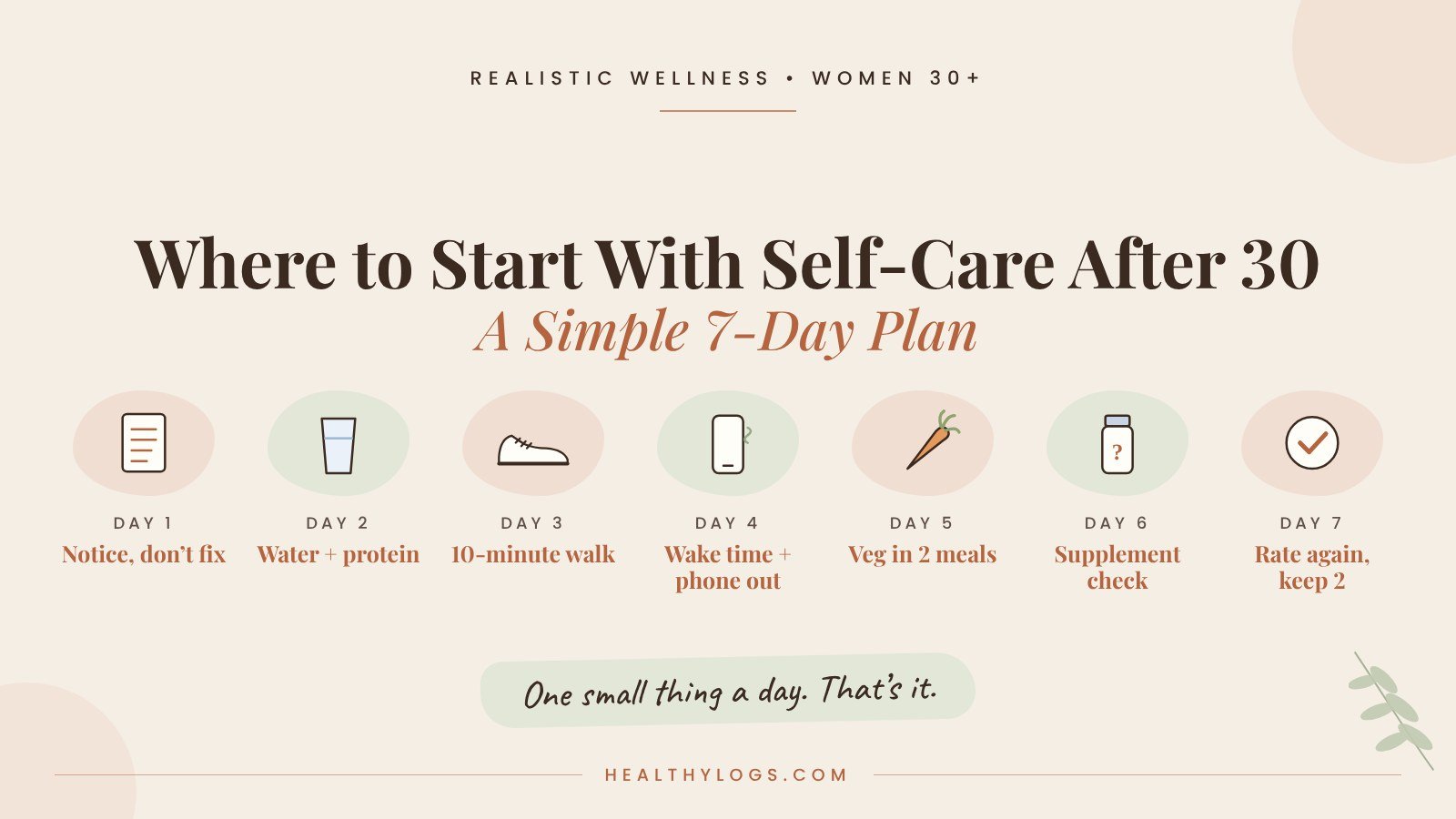
Pick the one minimum you're furthest from and start there this week. If you're starting from scratch, my 7-day self-care plan walks you through it one day at a time.
And if you keep losing steam when life gets busy, the missing piece may be your "why." My free Find Your Wellness Why worksheet takes about 15 minutes.
Free · 15-minute worksheet · 6 pages
Get the free Find Your Wellness Why worksheet
Go from a surface goal to a reason you can feel on a normal Tuesday, then match it with one gentle habit.
Free. You'll also get one short, honest email a week. Unsubscribe anytime.
FAQ
Is it too late to get healthy at 40 if I've always been busy?
No. The guidelines are the same for adults of every age, and in the UK Biobank study even a minute or two of daily vigorous bursts was linked to lower heart risk in middle-aged and older women.
What's the minimum exercise a busy woman needs?
US guidelines suggest 150 minutes of moderate activity a week plus 2 days of strength work. Bouts of any length count toward it.
Does exercising only on weekends count?
Research suggests it does. People who did most of their weekly activity in one or two days had heart benefits similar to those who spread it out.
This article is for general information and isn't medical advice. If you have a heart condition or haven't been active for a long time, check with your doctor before adding vigorous activity.
Sources
- U.S. Office of Disease Prevention and Health Promotion — Top 10 things to know about the second edition of the Physical Activity Guidelines for Americans
- UK Biobank — Vigorous intermittent lifestyle physical activity (VILPA) and major adverse cardiovascular events: evidence of sex differences. Stamatakis E et al., British Journal of Sports Medicine, 2024
- Harvard Gazette — Too busy for daily exercise? Be a weekend warrior (on Khurshid S et al., JAMA, 2023)
- Office on Women's Health (HHS) — Sarcopenia
- Cleveland Clinic — Perimenopause
- American Academy of Sleep Medicine — How much sleep do I really need?